
Quick Article Directory
Topic Research and Buyer Intent
Blog title: Open-Ear Earbuds Wholesale Guide: Fit, Sound Leakage, and Call Quality
Target keywords: open-ear earbuds wholesale, open-ear headphones supplier, air conduction earbuds bulk, sports earbuds sourcing, earbud leakage testing, private label open-ear audio
Search intent: Audio buyers evaluating open-ear designs for comfort, stability, awareness, leakage, and speech performance.
Why this topic fits a B2B export website: The query comes from buyers who are already comparing configurations, requesting samples, preparing a product range, or reducing risk before a bulk order. The topic connects technical selection with supplier control, packaging, compliance, shipment inspection, and a more precise request for quotation.
Direct Answer
Buyers evaluating open-ear earbuds wholesale should define the use case, freeze a measurable specification, test representative host and accessory combinations, and connect the approved sample to production inspection. Open-ear products should be selected through controlled wear trials and recorded call samples. A single listener and a short music demo cannot represent fit, leakage, or comfort across the target market. The lowest quotation is meaningful only when every supplier is pricing the same hardware, software, accessories, documentation, packaging, and quality plan.
Introduction
The commercial challenge in open-ear earbuds wholesale is not finding a product that appears to work during a short demonstration. It is selecting a repeatable configuration that will work for the intended customer, remain understandable to the sales channel, and arrive in bulk with the same behavior as the approved sample. That requires a written decision process rather than a collection of catalog screenshots.
This guide is written for sports retailers, audio distributors, travel brands, and wellness-product buyers. It focuses on procurement evidence: which specifications should be written into the RFQ, how compatibility should be tested, what factory testing can reasonably demonstrate, how shipment inspection should use the golden sample, and which claims need careful qualification. It does not replace destination-market legal advice or model-specific laboratory assessment.
The six target phrases are **open-ear earbuds wholesale**, **open-ear headphones supplier**, **air conduction earbuds bulk**, **sports earbuds sourcing**, **earbud leakage testing**, **private label open-ear audio**. They represent related buyer questions, but the article uses them as a coherent topic cluster rather than repeating them mechanically. That structure supports traditional search, Google AI Overviews, and answer engines that need clear, self-contained passages.
Start With the Product Application
The first sourcing decision is the intended application. For this category, common scenarios include outdoor exercise, office awareness, commuting, all-day voice and media use. Each scenario creates different priorities. A travel product may need compact dimensions, robust connectors, low weight, and protective packaging. An installed product may need stable firmware, clear setup instructions, replaceable parts, and predictable recovery after power or network loss.
Write one primary user scenario and no more than two secondary scenarios for the first SKU. Trying to serve every customer normally produces vague claims, unnecessary features, and a test plan that cannot be completed. The product brief should describe the user, host equipment, environment, expected session length, required accessories, regional version, and the problem the product must solve.
Use a panel with small, medium, and large ears, and ask each person to repeat a short movement routine. Photograph the driver position and score stability, pressure points, leakage, and voice clarity on the same form.
Before requesting price, review ByteAero product categories and decide whether the project is a standard wholesale configuration, a packaging customization, or a deeper ODM program. That distinction changes the sample sequence, tooling exposure, lead time, MOQ, and engineering evidence needed from the supplier.
Build a Measurable Specification Sheet
A reliable specification sheet turns catalog language into fields that can be verified. It should identify the exact model, revision, chipset or key component where relevant, materials, dimensions, interfaces, supported modes, included accessories, packaging, labels, manuals, carton data, and inspection method. Use "must" for required conditions and keep optional features in a separate list.
For open-ear earbuds wholesale, the core fields are:
- ear-hook geometry and adjustment
- driver position relative to the ear
- sound leakage at normal volume
- microphone beamforming behavior
- ingress-resistance claim
- case size and charging behavior
Avoid unsupported terms such as "universal," "professional," "ultra fast," or "waterproof." Replace them with a defined compatibility list, measured test condition, ingress-protection evidence, or operating limit. The supplier should be able to point to the approved record that supports every important retail claim.
Ear-hook geometry and adjustment
Document ear-hook geometry and adjustment in language that a factory, inspector, sales team, and customer-support team can interpret in the same way. Ask for the nominal value, applicable test condition, tolerance, and any dependency on another component. If a claim changes with host device, cable, power source, software, environment, or operating mode, that condition belongs beside the claim rather than in a footnote.
Driver position relative to the ear
Verify driver position relative to the ear in language that a factory, inspector, sales team, and customer-support team can interpret in the same way. Ask for the nominal value, applicable test condition, tolerance, and any dependency on another component. If a claim changes with host device, cable, power source, software, environment, or operating mode, that condition belongs beside the claim rather than in a footnote.
Sound leakage at normal volume
Measure sound leakage at normal volume in language that a factory, inspector, sales team, and customer-support team can interpret in the same way. Ask for the nominal value, applicable test condition, tolerance, and any dependency on another component. If a claim changes with host device, cable, power source, software, environment, or operating mode, that condition belongs beside the claim rather than in a footnote.
Compatibility Must Be Tested as a System
Pair with both major mobile operating systems and confirm call control, codec behavior, multipoint claims, and application support. Fit trials should include different ear sizes because acoustic consistency depends on driver position.
A useful compatibility matrix lists the host model, operating system or firmware, cable or adapter, power source, peripheral, test action, expected result, actual result, and known limitation. Preserve model numbers and software versions so the record can be repeated. "Works with laptops" or "supports Android" is too broad for a support team and too vague for shipment inspection.
Select a small but representative set rather than promising every device in the market. Include a current mainstream host, an older but common host, a value-tier host, and any platform central to the buyer's sales channel. Test the supplied accessories, not only laboratory cables. Packaging and product pages should communicate the boundary of the tested configuration.
Compare Suppliers on the Same Commercial Scope
Requesting three prices is not a supplier comparison unless each quotation covers the same configuration. Give every supplier the same product brief and ask them to identify exceptions. A comparison sheet should include unit configuration, MOQ, sample terms, customization cost, packaging, accessory list, lead time, carton data, warranty handling, test evidence, inspection support, Incoterm, and quotation validity.
Separate one-time costs from recurring costs. Tooling, artwork setup, certification work, application customization, or test fixtures should not be hidden in the unit price. Likewise, identify subscriptions, cloud fees, replacement consumables, proprietary cables, and software licenses that may affect the buyer or end user after sale.
Sample Evaluation Plan
Order enough samples to separate product evaluation from destructive or long-duration tests. Keep one sealed reference, use one or more units for functional and compatibility work, and reserve units for packaging, drop, endurance, or third-party assessment. Label every sample with supplier, model, revision, date, and intended use.
The sample plan should include these category-specific checks:
- run fit trials with multiple users
- measure audible leakage at set volume
- record calls indoors and outdoors
- test stability during movement
- verify left-right synchronization
- cycle the charging case and contacts
Record equipment, conditions, result, evidence file, and reviewer. Photographs help with appearance and setup, while screen recordings, logs, original media files, or meter exports support performance decisions. A pass/fail box without evidence becomes difficult to defend when suppliers or internal teams remember the test differently.
**Mid-article CTA:** Need a comparison-ready RFQ? Send your product requirements with the target market, quantity, application, required configuration, and timing. ByteAero can help organize the information needed for model matching and sample discussion.
Factory Testing and Golden Sample Approval
Factory testing should be tied to the product specification. A generic QC report with photographs of powered-on products does not prove the important functions. The buyer and supplier should agree which checks occur at incoming material control, assembly, aging, final functional test, packaging, and pre-shipment inspection.
The golden sample is the physical and documented reference approved after corrections. It should include product, accessories, firmware or app version, label, packaging, manual, barcode, color standard, and any agreed test data. Sign or seal the sample where practical and keep matching references with the buyer and supplier.
Production controls should focus on known risks. For this category, watch for bass claims unsupported by fit, uncomfortable hooks after long wear, excessive leakage in quiet rooms, microphone processing that sounds unnatural. Each risk needs either a design control, incoming-component control, in-process check, final test, or clear limitation in customer-facing information.
Shipment Inspection Before Release
A pre-shipment inspection checks whether finished goods match the approved reference; it is not a substitute for product development. Prepare the checklist before production. Include quantity, workmanship, functional sampling, accessories, labels, barcodes, packaging, carton markings, carton dimensions, gross and net weight, and model-specific critical tests.
Use an agreed sampling plan and classify defects as critical, major, or minor. Critical safety or identity issues should not be diluted by an overall defect percentage. Major functional or compatibility failures need containment and root-cause work. Cosmetic limits should be supported by photos so the inspector and factory use the same standard.
Safety, Compliance, and Labeling
Compliance depends on final model, destination, radio functions, power system, battery, materials, and sales channel. Ask a qualified testing or compliance professional which rules apply. Do not copy a certificate from a visually similar product or assume a component report automatically covers the finished device.
The evidence set may include a test report, declaration, technical documentation, label artwork, user instructions, importer information, battery documents, material declarations, radio information, and traceability records. Names and model numbers must match across the product, packaging, report, declaration, and commercial documents.
For an authoritative starting point relevant to this topic, review Bluetooth SIG LE Audio resources. Standards and programs evolve, so confirm the current edition and market-specific obligation before ordering. External links are educational references, not evidence that a particular ByteAero or supplier model is certified.
Packaging and Logistics Preparation
Packaging must protect the actual weak points of the product. Inspect connector restraint, screen or surface protection, accessory separation, cable bending, moisture sensitivity, and movement inside the box. Retail packaging should survive master-carton handling without creating false cosmetic failures at receiving.
Approve the carton pack quantity, internal dividers, carton material, sealing method, shipping marks, barcode placement, dimensions, and weight. Request photos of the packed master carton and conduct suitable transport simulation based on product risk and sales channel. E-commerce distribution may need stronger individual protection than palletized retail delivery.
If the product includes a lithium battery, confirm model-specific test documentation, battery marks, watt-hours, state-of-charge requirements where applicable, packaging instructions, and carrier acceptance. Freight rules and carrier policies can change, so the logistics provider should review the final configuration before booking.
Price Differences and Landed Cost
Price variation usually reflects more than supplier margin. Key components, chipset grade, enclosure materials, battery cells, adapters, cables, software, certification scope, test time, packaging, warranty reserve, and order volume can all change cost. Ask suppliers to explain meaningful gaps rather than demanding that every quotation converge on the lowest number.
Calculate landed cost with unit price, tooling, artwork, testing, inspection, inland transport, freight, insurance, duty, tax, brokerage, financing, warehousing, expected defect handling, and replacement accessories. A slightly higher unit price can produce a lower commercial cost if it reduces returns, support cases, airfreight, or late rework.
RFQ Checklist for Buyers
A useful inquiry should state:
- target country and sales channel
- expected order quantity and forecast
- primary product application
- the six critical specifications from this guide
- representative host devices or systems
- required accessories and regional power version
- logo, color, packaging, barcode, and manual needs
- compliance and documentation expectations
- sample quantity and approval schedule
- requested Incoterm, destination, and target shipment date
Attach a simple specification table and ask the supplier to answer every row with "complies," "does not comply," or a stated alternative. This produces faster, more comparable responses than a message asking only for the best price.
FAQ
What is the first step when sourcing open-ear earbuds wholesale?
Define the target user, market, application, required configuration, and testable acceptance criteria. Send the same written brief to each supplier so quotations and samples can be compared on an equal basis.
How many samples should a B2B buyer order?
Order enough to keep one reference, test representative functions and compatibility, and complete any endurance, packaging, or third-party assessment. The exact number depends on product complexity and the consequence of failure.
What should factory testing cover?
Factory testing should verify the critical specifications and known failure modes of the approved model. It should use defined equipment, limits, sampling or coverage, records, and responsibility for failed units.
What belongs in the golden sample record?
Keep the approved product, accessories, firmware or app version, labels, artwork, manual, barcode, packaging, color reference, configuration sheet, and important test evidence together under one revision.
When should shipment inspection occur?
Inspection should occur when production is complete and enough goods are packed to represent the shipment, but before final release and freight collection. Timing should allow correction if the result is not acceptable.
How can buyers reduce compatibility complaints?
Publish a model-level compatibility matrix, use the supplied accessories during tests, state known limitations clearly, and repeat key checks whenever hardware, firmware, application, or controlled components change.
Image Planning and AI Prompts
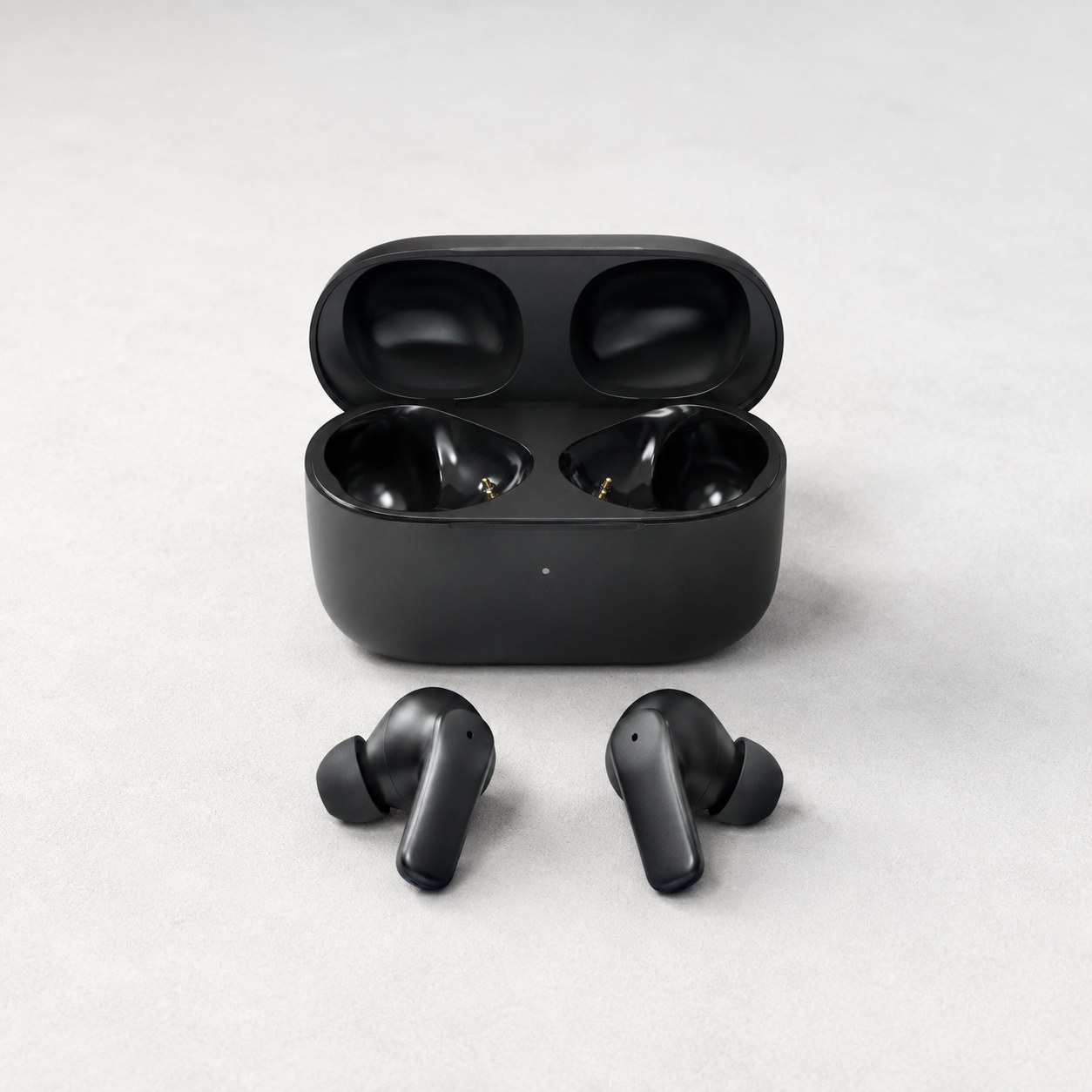
Image 1: Product configuration overview
Purpose: Show the complete product and accessory set so buyers can understand the configuration.
Insert position: After "Build a Measurable Specification Sheet."
English caption: "The complete sample configuration should be approved before packaging and mass production."
ALT text: "open-ear earbuds wholesale product configuration and accessories for B2B sourcing."
AI image prompt: Realistic commercial product photography of a pair of open-ear earbuds fully visible beside a charging case on a neutral retail photography set, clean neutral studio, accurate proportions, all accessories fully visible, natural shadows, no text, no logos, no futuristic styling, looks like a genuine B2B catalog photo, 3:2 landscape.
Image 2: Factory testing and quality control
Purpose: Demonstrate a realistic category-specific inspection or performance test.
Insert position: After "Factory Testing and Golden Sample Approval."
English caption: "Factory testing should reproduce the critical conditions defined in the buyer's specification."
ALT text: "Asian technician performing open-ear earbuds wholesale factory quality-control testing."
AI image prompt: Documentary-style factory quality-control photograph of Asian audio technician conducting fit, leakage, and call-quality testing with open-ear earbuds, Asian technician wearing normal factory work clothing, realistic electronics test equipment, bright clean production environment, candid professional composition, natural skin texture, no text, no logos, not cinematic, not obviously AI-generated, 3:2 landscape.
CTA and Inquiry Popup Plan
Mid-article CTA: Place "Send Your Requirements" after the sample evaluation section. Link it to the inquiry page and ask for target market, quantity, configuration, and timing.
End CTA: Place "Get a Quote" after the conclusion. Keep the request practical and avoid urgency or unsupported savings claims.
Popup trigger: Show after 40% scroll or 30 seconds of engaged reading. Use exit intent only on desktop and do not show the popup again after dismissal during the same session.
Popup title: "Send Your Product Requirements"
Popup copy: "Tell us the product, market, quantity, and configuration you need. ByteAero will review the request and reply with relevant sourcing questions."
Required fields: Name, Email, Phone. Optional fields: Company, Country/Region, Product Requirements, Message.
Submit button: "Send Requirements"
Conclusion
Open-Ear Earbuds Wholesale Guide: Fit, Sound Leakage, and Call Quality is ultimately a process-control topic. Define the use case, create a measurable specification, compare suppliers on equal scope, test representative systems, approve a controlled golden sample, and inspect finished production against that reference. Open-ear products should be selected through controlled wear trials and recorded call samples. A single listener and a short music demo cannot represent fit, leakage, or comfort across the target market.
For a focused supplier discussion, get a quote from ByteAero. Send the target country, sales channel, quantity, intended application, critical features, packaging needs, and planned delivery window so the response can address the real procurement decision.