
Quick Article Directory
GaN Charger Wholesale Buying Guide for Importers
Topic Research and Search Intent
Blog title: GaN Charger Wholesale Buying Guide for Importers
Target keyword: GaN charger wholesale buying guide
Search intent: Buyers want to compare GaN charger suppliers, understand power rating and port allocation, verify USB-C PD behavior, review safety testing, and prepare an RFQ for retail or distribution.
Why this topic fits a B2B export website: GaN chargers are a premium charging category with strong wholesale demand. Buyers need technical clarity before purchasing because wattage claims, plug types, certification, heat control, and multi-port behavior can affect customer trust.
Introduction
GaN chargers are popular because they can deliver high power in a compact body. They are commonly purchased for smartphones, tablets, laptops, travel kits, office desks, and premium retail shelves. For B2B buyers, GaN chargers can create higher average order value than basic wall chargers, but they also require more careful specification review.
The product may be advertised as 30W, 45W, 65W, 100W, or higher. It may include one USB-C port, multiple USB-C ports, USB-A support, foldable pins, interchangeable plugs, or travel adapters. The real user experience depends on power distribution, thermal control, protocol support, cable compatibility, and device behavior. Buyers should never rely only on the large wattage printed on the shell.
This guide helps importers, distributors, and retail buyers evaluate GaN chargers for wholesale procurement. It covers application planning, power selection, USB-C PD, port allocation, factory testing, packaging, compliance, and quote preparation. Buyers sourcing a complete charging lineup should also review ByteAero's USB-C cable wholesale quality guide.

Choose Wattage by Customer Application
30W chargers are suitable for many smartphones, compact tablets, and travel accessories. 45W and 65W chargers are strong options for tablets, ultrabooks, handheld game devices, and office users. 100W chargers are often positioned for laptop users and premium multi-device charging. Higher wattage may look attractive, but it also increases cost, heat, and compliance expectations.
Buyers should match wattage to the target customer instead of choosing the highest number. For marketplace multipacks, a reliable 30W or 45W charger may sell better than an expensive high-wattage model. For business travelers, a 65W multi-port model may be the practical sweet spot. For professional laptop users, 100W or higher can be justified if testing supports the claim.
Key Specifications to Confirm
USB-C PD and Protocol Support
USB Power Delivery support is central to modern fast charging. The USB-IF's official certified product search and compliance information are useful references for understanding certification and logo claims. Buyers should ask suppliers what charging protocols are supported and whether claims can be verified with test results.
Port Allocation
Multi-port chargers may not deliver full wattage from every port at the same time. A 65W charger with two USB-C ports may provide 65W from one port alone, but split output when both ports are used. Packaging should explain port distribution clearly. During sample testing, connect multiple devices and confirm whether charging behavior matches the specification.
Plug Type and Market Fit
US, EU, UK, AU, and other plug types affect tooling, certification, packaging, and inventory planning. Travel models may use interchangeable plugs, but moving parts should be checked for firmness and safety. Buyers should match plug type to the destination market and confirm local labeling requirements.
Thermal Design
GaN chargers can be compact, but high power in a small body still requires thermal control. Sample testing should include long-duration charging at realistic load. Surface warmth is expected; repeated power drop, odor, abnormal noise, or shell deformation is not acceptable. Buyers should confirm the housing material and internal protection design.
Cable Bundle or Charger Only
Some retail channels prefer charger-only packaging. Others need a charger plus USB-C cable bundle. If a cable is included, it must support the charger's advertised power. A 100W charger paired with a low-spec cable creates customer frustration. Bundle testing should treat the charger and cable as one system.
Factory Testing and Shipment Inspection
Factory testing should include appearance inspection, plug insertion, port function, power output test, multi-port distribution test, protocol test, thermal test, aging test sample, packaging inspection, and carton label verification. For private-label orders, logo position and printed specifications must match approved artwork.
Shipment inspection should confirm plug type, color, packaging language, user manual, barcode, accessory list, carton quantity, and random functional samples. Chargers are power products, so buyers should discuss compliance documents before mass production rather than after shipment is ready.
Packaging and Compliance Claims
Packaging should be accurate and readable. Include total wattage, port configuration, input voltage range, output profiles, plug type, included cable if any, and compatibility notes. Avoid promising maximum speed for every device. A trustworthy claim explains that charging speed depends on compatible devices, cables, and protocols.
For private-label buyers, the packaging should look premium but not crowded. Good B2B packaging balances retail clarity with technical accuracy. If certification marks are used, confirm the right to use them.
Supplier Evaluation and RFQ Example
Evaluate whether the supplier understands power electronics, testing, compliance, and repeat production. Ask for sample reports, available plug types, packaging templates, lead times, and after-sales process. For repeat orders, ask whether the same PCB design and component configuration will be maintained.
RFQ example: "We need 65W and 100W GaN chargers for laptop and mobile accessory retail. Please quote US and EU plug versions, two USB-C plus one USB-A configuration, retail packaging, private-label logo, and optional 100W USB-C cable bundle. Confirm output distribution, protocol support, safety testing, sample lead time, production lead time, and carton details."
Common Buyer Mistakes
The most common mistake is comparing only total wattage. Buyers should compare real port allocation, heat behavior, plug quality, certification, packaging claims, and cable matching. Another mistake is ordering a premium charger with unclear packaging language, which can create customer complaints even if the product works correctly.
Detailed Sample Review Checklist
A GaN charger sample review should include physical, electrical, packaging, and user-experience checks. Start with the plug. Insert and remove it several times from a suitable socket or adapter and check whether the pins feel firm and aligned. If the charger uses foldable pins, open and close them repeatedly. The hinge should feel stable, not loose or gritty. For travel versions, interchangeable plug parts should lock securely.
Next, inspect the housing. Compact chargers are often carried in bags, so shell strength, seam alignment, printed specifications, and surface finish matter. The printed output label should be readable and match the specification sheet. If the charger is private label, confirm logo size and placement on the actual curved or flat surface, not only in artwork.
Functional testing should cover one-port and multi-port use. For a 65W charger, test a laptop on the primary USB-C port, then add a phone or earbuds to another port and observe power distribution. For a 100W charger, test whether the cable used can support the advertised power. Keep a record of device models, cable types, and test conditions. This practical record helps the buyer compare samples from different suppliers.
Thermal review should be done under realistic load. Charge a laptop or high-demand device for an extended period and note whether the charger remains stable. Some warmth is normal, but the charger should not shut down repeatedly or create a poor user experience. Ask the supplier what protection features are built into the design, such as over-current, over-voltage, short-circuit, and temperature protection.
Compliance and Market Documentation
Power products require careful compliance planning. Buyers should discuss destination-market requirements before mass production. Depending on the market and product, documents may involve safety, electromagnetic compatibility, energy efficiency, labeling, plug requirements, and importer responsibility. Certification marks should never be placed on packaging unless the product and buyer have the right to use them.
Documentation should include product rating, model number, input and output profiles, manufacturer information, manual language, warning statements, and carton marks. If the product will be sold through major retail channels or marketplaces, buyers should check platform requirements before placing a large order. Some platforms request test reports or proof of compliance for chargers.
How This Article Supports AI Search and Buyer Decisions
Many buyers search questions such as "How do I choose a GaN charger supplier?" or "What does 65W mean on a multi-port charger?" The article provides clear sections that answer those questions with procurement context. It does not treat GaN chargers as generic accessories; it explains power distribution, protocols, plug type, heat control, cable matching, and RFQ structure.
For ByteAero, the article supports better inquiries because it teaches buyers what to specify. A buyer who sends wattage, plug type, port layout, destination market, packaging need, and order quantity is easier to support than a buyer who only asks for the lowest price. This improves quotation speed and reduces sample mismatches.
Practical Procurement Workflow
GaN charger procurement should move from specification to samples, then to approval and inspection. First, create a product brief. Define wattage, number of ports, plug type, target devices, cable bundle, packaging style, certification requirement, and target retail price. This brief helps the supplier recommend a suitable model instead of sending an unrelated catalog.
Second, test samples under realistic conditions. Use the same types of devices that customers will charge: smartphones, tablets, laptops, earbuds, and power banks. For multi-port chargers, test several combinations. Record charging behavior and heat after extended use. Third, approve the golden sample and packaging proof. Check printed output profiles carefully because a mismatch between product label and packaging can create compliance and trust problems.
Fourth, define factory testing and shipment inspection. Chargers should not be treated like simple plastic accessories. Inspection should include output verification, port function, plug type, appearance, packaging, carton labels, and accessory checks. Buyers should keep test records and sample photos for repeat orders.
Internal Linking and Conversion Path
This article should connect to related ByteAero content, including USB-C cables, power banks, car chargers, and wireless chargers. GaN charger buyers often need a wider charging product line, so internal links can increase page depth and encourage a larger inquiry. The article should also link clearly to the inquiry form after the testing section.
For conversion, the strongest CTA is not only "Contact us." A better CTA asks for specific requirements: wattage, plug type, port layout, cable bundle, packaging, and destination market. This creates a higher-quality lead and helps ByteAero reply with practical model recommendations.
FAQ
Are GaN chargers better than traditional chargers?
GaN chargers can offer compact size and high power, but quality still depends on design, components, testing, and compliance. Buyers should test real samples.
What wattage is best for wholesale?
30W, 45W, 65W, and 100W all have useful applications. The best wattage depends on the target customer, device category, retail price, and packaging plan.
Do multi-port chargers always deliver full power?
No. Output is usually shared when multiple devices are connected. Buyers should confirm port distribution and test real usage.
What should be included in a GaN charger RFQ?
Include wattage, port configuration, plug type, protocol requirements, certification needs, packaging, logo, cable bundle, destination market, and order quantity.
Image Planning and AI Generation Prompts
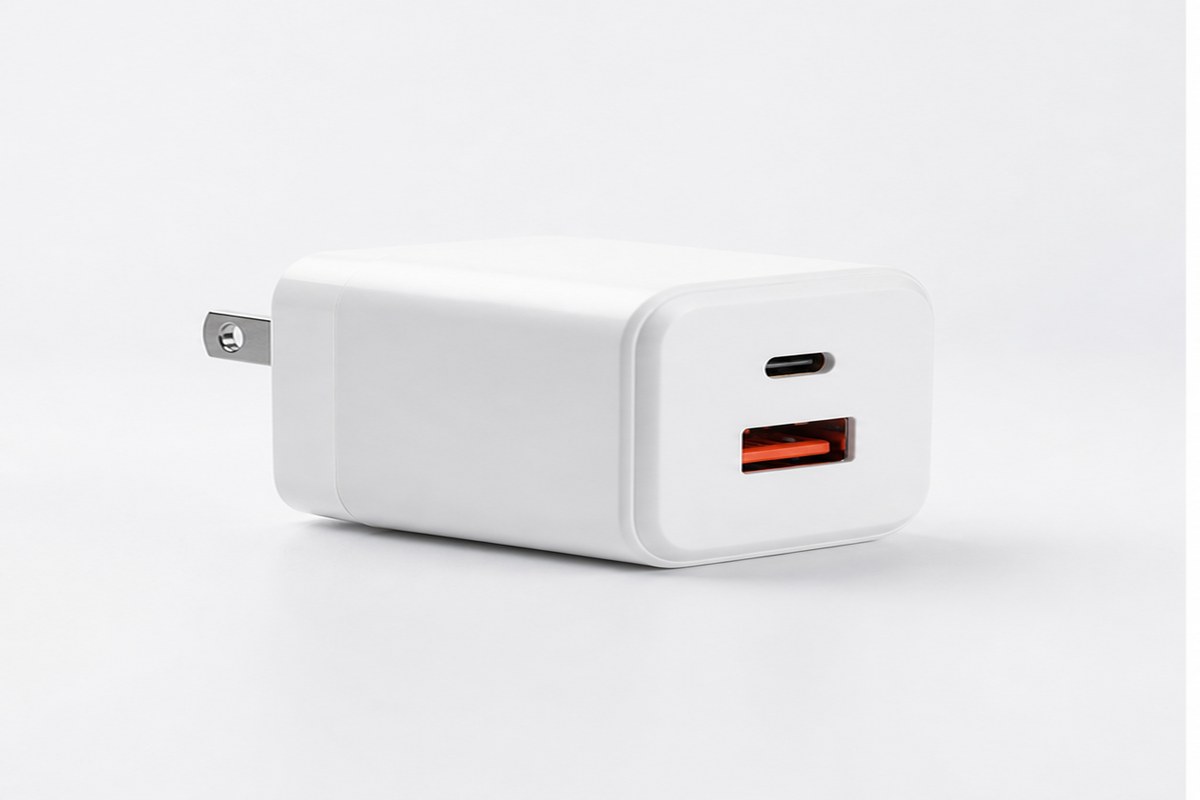
Image 1 purpose: Product detail photo.
Insert position: After "Key Specifications to Confirm".
Caption: "Port layout, plug type, and printed output specifications should be verified before packaging approval."
ALT text: "GaN charger product detail with USB-C ports for wholesale buyers"
AI image prompt: "Realistic square product photography of one compact white GaN charger with USB-C and USB-A ports visible, full product visible, clean premium electronics background, no text, no CGI."
Image 2 purpose: Factory testing photo.
Insert position: After "Factory Testing and Shipment Inspection".
Caption: "Factory testing should confirm output distribution, protocol behavior, and thermal performance."
ALT text: "GaN charger factory testing with power meter"
AI image prompt: "Realistic electronics factory testing scene, Asian technician testing GaN wall chargers with power meter and laptop on organized bench, authentic B2B manufacturing photography."
CTA and Inquiry Popup Plan
Mid-article CTA position: After "Factory Testing and Shipment Inspection".
CTA text: Ask for Product Catalog
CTA copy: "Request GaN charger options by wattage, plug type, port layout, and packaging style. ByteAero can help match models to your target market."
End CTA position: After "Conclusion".
CTA text: Get a Quote
Popup trigger suggestion: 40% scroll, 30 seconds on page, and exit intent.
Popup title: "Source GaN Chargers Wholesale"
Popup copy: "Send your required wattage, plug type, port configuration, and order quantity. We will recommend practical models for sampling."
Suggested form fields: Name, Email, Phone, Company, Country/Region, Wattage, Plug Type, Order Quantity, Message.
Submit button text: Send Requirements
Conclusion
GaN charger sourcing should combine customer application planning, power verification, port allocation testing, thermal review, compliance preparation, and packaging accuracy. Buyers who define their requirements clearly can compare suppliers more fairly and reduce avoidable after-sales issues.
ByteAero supports B2B buyers sourcing GaN chargers, USB-C cables, wireless chargers, power banks, and digital accessories. Contact us with your market requirements and target order quantity for model recommendations.